

Coverage 24/7 or 8/5 by contractP1 / P2 / P3LONDON · LISBON · RECIFE · BOGOTÁ · HANOIUTC --:--:--
OEM support solutions
● Coverage 24/7 or 8/5 by contract  |  P1 / P2 / P3London · Lisbon · Recife · Bogotá · Hanoi

Services

One accountable route when support ends, incidents escalate or hardware fails.

Recurring multivendor TAC, senior one-off intervention and compatible hardware for live telecom networks. Scope, access, escalation and technical closure are agreed before work begins.

Independent since
2018
Vendors in public coverage
13
Senior TAC engineers in our network
100+
Hardware suppliers worldwide
100+

Choose your starting point

Scope controlled

The controls stay the same, whichever route you choose.

One operating model

  1. 01

    Scope confirmed

    Platforms, boundaries and exclusions

  2. 02

    Severity agreed

    Priority, targets and service window

  3. 03

    Access controlled

    Client-approved method and timing

  4. 04

    Senior ownership

    One accountable technical lead

  5. 05

    Closure recorded

    Outcome, evidence and next action

Customer-controlled access · documented case record · escalation defined before work begins

01 / Recurring Multivendor TAC

One SLA across the vendors in scope. One senior owner through technical closure.

Recurring L2/L3 support for the platforms you choose to keep in service. The contract defines covered vendors and releases, severity rules, response targets, access, exclusions and escalation before go-live.

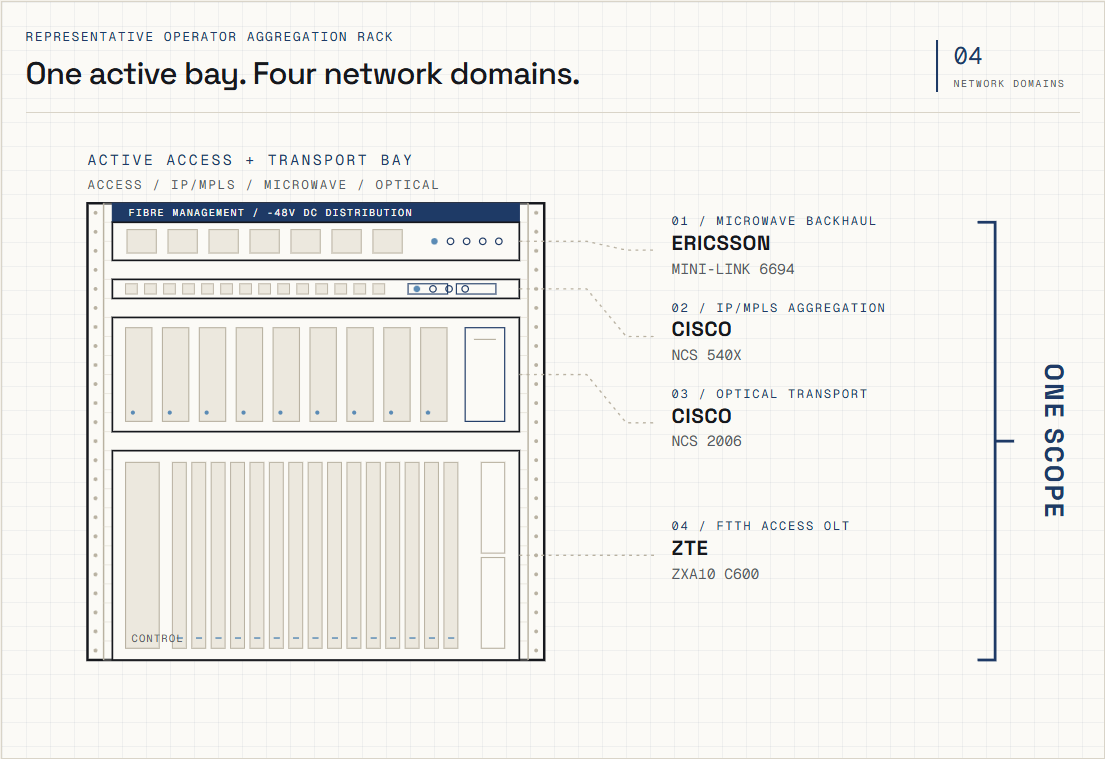
Multivendor rack elevation with covered platform modules
One agreement across the platforms in the rack — scope confirmed per vendor, release and domain

Commercial basis

Pricing follows your install base, vendor mix, service window, case history and operational risk. The proposal separates base scope, options, assumptions and exclusions so procurement can compare like with like.

What the contract controls

  • 01Exact vendors, platform families, software releases and exclusions
  • 02P1 / P2 / P3 definitions, response targets and service window
  • 03Named case ownership and domain-lead escalation
  • 04Customer-controlled access and an agreed update cadence
  • 05Technical closure through resolution, workaround, documented escalation or evidence-based RCA

The support module

Two ways to place us in your escalation chain.

On legacy estates we are the last level of escalation. On current equipment we run TAC 2/3 while your vendor contract keeps R&D and emergency cover — you decide the module per platform.

Module 01 / TAC 3 ownership

Legacy & end-of-support estates

When the manufacturer
no longer carries the platform

Level 1

Your NOC

First response and case intake inside your operation.

Level 2

Your operations team

Field and platform operations, as today.

Level 3 — final escalation

OEM Support Solutions TAC 3

Senior multivendor engineering owns the case to fix, workaround or evidence-based RCA.

One contract across vendors · end-of-support platforms stay supported

Coverage
24/7 or 8/5 by contract
Restoration
Targets agreed per severity
OPEX
Reduction up to 50%

OPEX basis: vs stacked OEM renewals on comparable scope

Module 02 / TAC 2–3 alongside the vendor

Current equipment, vendor contract retained

You keep the vendor for
R&D and emergency support

Level 1

Your NOC

First response and case intake inside your operation.

Level 2

OEM Support Solutions TAC 2

Senior triage, troubleshooting and ticket reduction before anything reaches the vendor.

Level 3

OEM SS TAC 3 / vendor L3

Deep diagnosis; vendor engaged only where the platform boundary requires it.

Level 4

Vendor R&D

Code-level fixes and emergency support under your retained vendor contract.

Vendor escalation preserved · fewer tickets reach the vendor · KPI improvement

Coverage
24/7 or 8/5 by contract
Vendor boundary
R&D & emergency retained
OPEX
Reduction up to 50%

OPEX basis: vs stacked OEM renewals on comparable scope

An indicative 30-day mobilisation

A typical sequence, not a fixed commitment. Timing adjusts to access readiness, available technical information and the controls agreed for go-live.

  1. D-0101 / 05

    Confirm scope and ownership

    Covered platforms, exclusions, contacts and responsibilities are aligned.

  2. D-0702 / 05

    Test intake and escalation

    Ticketing, notifications and escalation routes are exercised with your team.

  3. D-1403 / 05

    Build the technical baseline

    Topologies, case history, known problems and operational risks are reviewed.

  4. D-2104 / 05

    Agree access and emergencies

    Access controls and written emergency procedures are approved and shared.

  5. D-3005 / 05

    Readiness review and go-live

    The support route is activated once the agreed operational controls are ready.

Assessment dossier

A decision-ready support brief, not a generic quote.

The assessment converts the install base and case history into four concrete outputs procurement and network operations can evaluate together.

01

Coverage map

The vendors, platform families, releases and support boundaries proposed under one agreement.

02

Service options

P1/P2/P3 definitions, response targets and 24/7 or 8/5 coverage options for the agreed scope.

03

Ownership and dependencies

The case owner, domain escalation and external dependencies that can pause or extend the support clock.

04

Access and closure

The approved access method, update cadence, case record and technical closure criteria.

Decision output

A proposed recurring support scope with service options, assumptions, exclusions and commercial basis built on your actual network and case history.

Assess recurring coverage

02 / Incident & One-off Support

Senior intervention when the normal escalation path has run out.

One-off technical support for critical incidents, corrupted systems and complex multivendor faults, without requiring a standing support contract. The intervention boundary is agreed before access.

What you send

  • Affected service and operational impact
  • Vendor, platform and software release
  • Symptoms, alarms, logs and topology
  • Actions already taken and current hypothesis
  • Access availability and operating window

What you receive

  • Senior technical triage and an agreed intervention boundary
  • Status updates and technical actions in the case record
  • Fix, workaround or documented escalation path
  • Closing record, open risks and recommended next action
  • RCA where the available evidence supports one
  • Coordination across the relevant vendor domains
  • No retainer, and no requirement to convert to a support contract
Send an incident brief

03 / Hardware & Spare Parts

Source the right part, not merely the right part number.

Line cards, optics, modules, chassis components and repairable units for current, legacy and end-of-support telecom estates.

Hardware suppliers worldwide
100+
Condition stated on every quote
NEW / REF
Warranty and RMA route documented
B2B
Delivery window confirmed before purchase
QUOTE
Engineer seating a line card in a telecom chassis

Start with the equipment

Send one part number, a BOM or a clear chassis photograph.

No support contract is required. We return the availability, condition, compatibility basis, warranty route and delivery window.

01Part number02BOM03Chassis photo

Representative vendor enquiries

13

Across the equipment already in your network.

Cisco01
Ericsson02
Nokia03
Huawei04
Ciena05
Infinera06
Juniper07
ZTE08
Ceragon09
NEC10
Mavenir11
Ribbon12
Motorola13

Hardware range

From access shelves to coherent optics.

Start with a part number, BOM, equipment label or chassis photograph. We verify the exact platform, release dependency, condition and delivery requirement.

01

Fixed access

OLT / ONT · DSLAM / MSAN · PON cards · Control & power

02

IP and packet

Routers & switches · Route processors · Interface cards · Fabric cards

03

Optical transport

OTN / DWDM · SDH / PDH · Line cards · Transponders

04

Microwave transport

Indoor units · Modem cards · Controllers · Power units

05

Mobile infrastructure

Mobile core · Baseband units · Control cards · Common units

06

Optics and common units

SFP / QSFP · Coherent optics · Power supplies · Fan trays

The spares sourcing chain

From requirement to confirmed delivery.

RFQ

Request

Part number, platform, release, quantity.

100+

Hardware suppliers

Sourced worldwide, new and refurbished.

B2B

Warranty

Terms and RMA route stated on the quote.

ETA

Delivery

Confirmed before purchase and tracked.

New, refurbished and repair routes are assessed per request

Project delivery and dedicated engineering

04 / Network Upgrades & Integration

Execute the maintenance window without overloading the operator team.

Small-scale upgrade implementation, system integration and targeted migration, planned around controlled change windows and an agreed handover.

  • Upgrade implementation during planned windows
  • Defined system integration scope
  • Targeted platform or service migration
  • Method, pre-checks, rollback and validation
  • Remote-first, hybrid or on-site delivery

05 / Telecom Contract Engineering

Add a named specialist to the operator team for as long as the work requires.

Telecom engineers engaged through OEM Support Solutions for 3 to 24 months, working under the operator's day-to-day technical direction.

  • Telecom-specific search and technical screening
  • Remote, hybrid and on-site delivery
  • Monthly customer engagement through OEM Support Solutions
  • Operator-directed day-to-day technical work
  • Three to twenty-four month assignments

Start with what you know

The network, the change, the part or the specialist.

Start with the requirement in front of you. Each route has its own technical brief, commercial boundary and next step.